
Tree support
Tree Cabling and Bracing
Cabling and bracing add support to a tree with a structural weakness, most often a narrow V-shaped fork between two trunks. A cable high in the crown limits how far the stems can move apart, and a rod through the fork holds it together lower down.
Call availability varies by area and time of day. Calls are answered by an independent tree service provider.
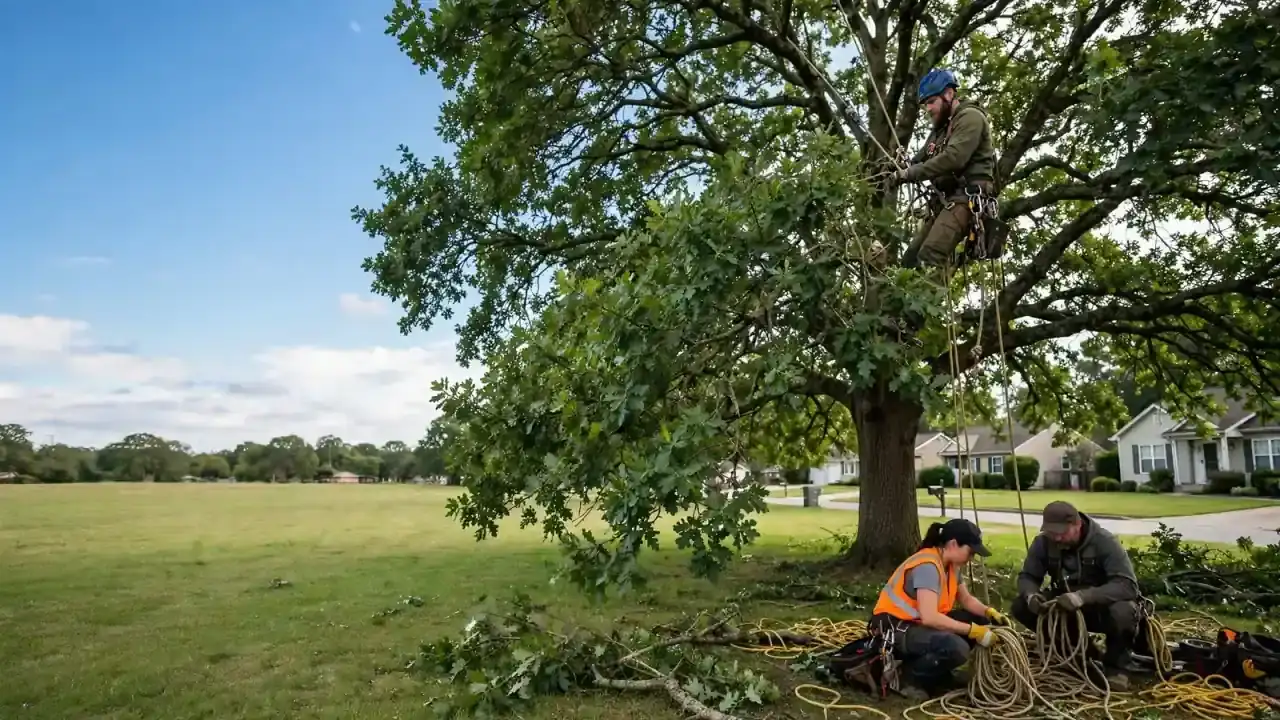
What a cable actually does
Two trunks rising from one fork each sway in their own direction in wind. Where the fork is tight and bark is trapped between them, the joint has little wood holding it together, and the movement works it apart a little more each storm.
A cable is installed about two thirds of the way from the fork to the tips of the stems it connects. At that height it has enough leverage to stop the stems spreading far, without making the whole tree rigid. The tree still moves, which matters, because wood grows stronger where it flexes.
Bracing rods are threaded steel rods run through the trunk at or just above a fork or crack. They resist twisting and splitting at that spot. Rods are usually combined with a cable above them, because a rod alone cannot control the leverage of a long stem.
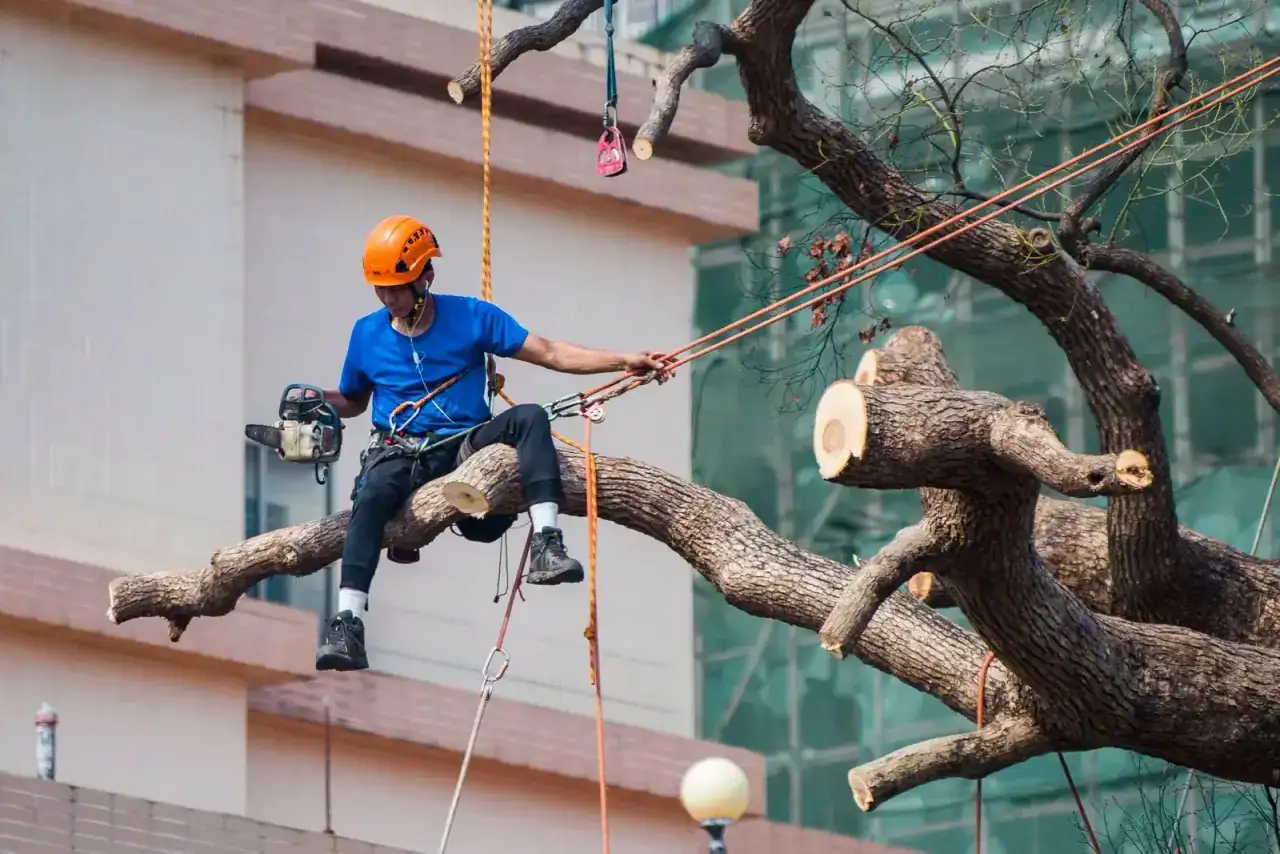
Which trees are good candidates?
A tree that is healthy and worth keeping but has one defined structural weakness: a codominant fork with included bark, a long horizontal limb over a target, or an old crack that has not yet opened. Cabling is not a fix for decay, root problems or a tree that is already leaning.
- Good candidate
- A vigorous oak, maple or elm with a tight V fork and no decay at the joint.
- Borderline
- A fork that has already cracked slightly. A rod and cable can work, but an arborist must judge how much sound wood remains.
- Not a candidate
- Hollow trunks, root rot, a tree that has started tipping or a split already open more than a hand's width.
Support, prune or remove
Find the line that matches your tree, then confirm it with an on-site inspection.
- Act now
A fork has split open and the halves are moving
Keep people away and call for emergency assessment. This is usually a removal.
- This week
Two trunks share a tight V with bark pinched between them
Cable the stems and reduce the weight at their ends.
- Plan it
A long limb reaches over the roof with a slight droop
Reduce its length first. Cable it only if reduction alone is not enough.
- This week
Existing cables are rusted, slack or grown into the bark
Have them inspected and replaced. A slack cable gives no support.
- This week
There is a hollow or fungus at the fork
Get a risk assessment before any hardware goes in.
How a support system is installed
Inspect the defect
The climber checks the fork, the wood around it and the health of the crown before choosing hardware.
Reduce weight
Pruning usually comes first, to take load off the ends of the stems that will be cabled.
Drill and fit anchors
Eye bolts or lag hooks are set into sound wood, aligned so the cable pulls in a straight line between them.
Tension the cable
Steel cable is set with a little slack. Dynamic synthetic systems are fitted around the stems without drilling.
Record it
The installer should note what was installed, where, and when it needs inspection.
Static and dynamic systems
| System | Material and fitting | Where it fits |
|---|---|---|
| Static steel cable | Extra-high-strength steel strand between drilled eye bolts | Heavy stems and forks with included bark, where firm restraint is needed |
| Dynamic synthetic cable | Braided rope with a shock absorber, attached with slings rather than bolts | Younger trees and lighter limbs, allowing more natural sway |
| Brace rod | Threaded steel rod through the trunk, fixed with washers and nuts | Cracks and forks that need to be held against splitting |
| Guying | Cable from the tree to a ground anchor | Rarely used on mature trees. Mostly for newly planted or transplanted trees |
Hardware and installation practice in the United States is set out in the ANSI A300 standards for supplemental support systems.
Signs an existing cable needs attention
Cable hanging slack
Either the hardware moved or the stems have grown. It is no longer doing its job.
Bark swallowing the eye bolt
Normal over time, but the hardware should be checked for movement and corrosion.
Rust streaks or frayed strands
Corroded steel loses strength and can snap in a storm.
A new crack below the old cable
The defect has moved. The system needs to be redesigned, not tightened.
No one can say when it was installed
Cables older than ten to fifteen years without inspection should be assessed.
Work that often goes with cabling
- Crown reduction
- Shortening heavy stems with crown reduction lowers the load the cable carries.
- Deadwood removal
- Dead branches in the crown are taken out while the climber is already in the tree.
- Lightning protection
- Tall specimen trees with cables sometimes get a lightning protection system at the same visit.
- Annual inspection
- Cables and rods should be looked at every year or two and after major storms.
Cabling and bracing questions
Does cabling hurt the tree?
Drilling makes small wounds that a healthy tree closes over. Synthetic systems avoid drilling altogether. Both are far less damaging than a fork splitting open.
How long does a tree cable last?
Steel systems are often serviceable for decades if inspected, but trees grow and hardware corrodes, so periodic adjustment or replacement is expected.
Can a split tree be bolted back together?
Sometimes, if the split is fresh and small and the tree is healthy. Once the halves have separated widely or decay has entered, bolting rarely holds.
Will cabling guarantee the tree will not fail?
No. Support systems reduce the chance of a specific failure. They do not make a tree storm-proof, and they do nothing for root problems.
Talk to a tree cabling and bracing provider
Call to be connected with an independent tree service company near you.
(844) 955-1716Call availability varies by area and time of day
Limbwright is a referral service. Your call goes to an independent tree service company that sets its own schedule and terms. Ask for proof of insurance and a written scope before work starts. How this works
Call now
Talk to a tree service provider in your area. Have the tree's location and what it is near ready.
(844) 955-1716Call nowCall availability varies by area and time of day