
Planting
Tree Planting
Most young trees that die in their first few years were planted too deep, watered too little or put in the wrong spot. Professional planting is mostly about avoiding those three mistakes, and choosing a tree whose mature size fits the space.
Call availability varies by area and time of day. Calls are answered by an independent tree service provider.
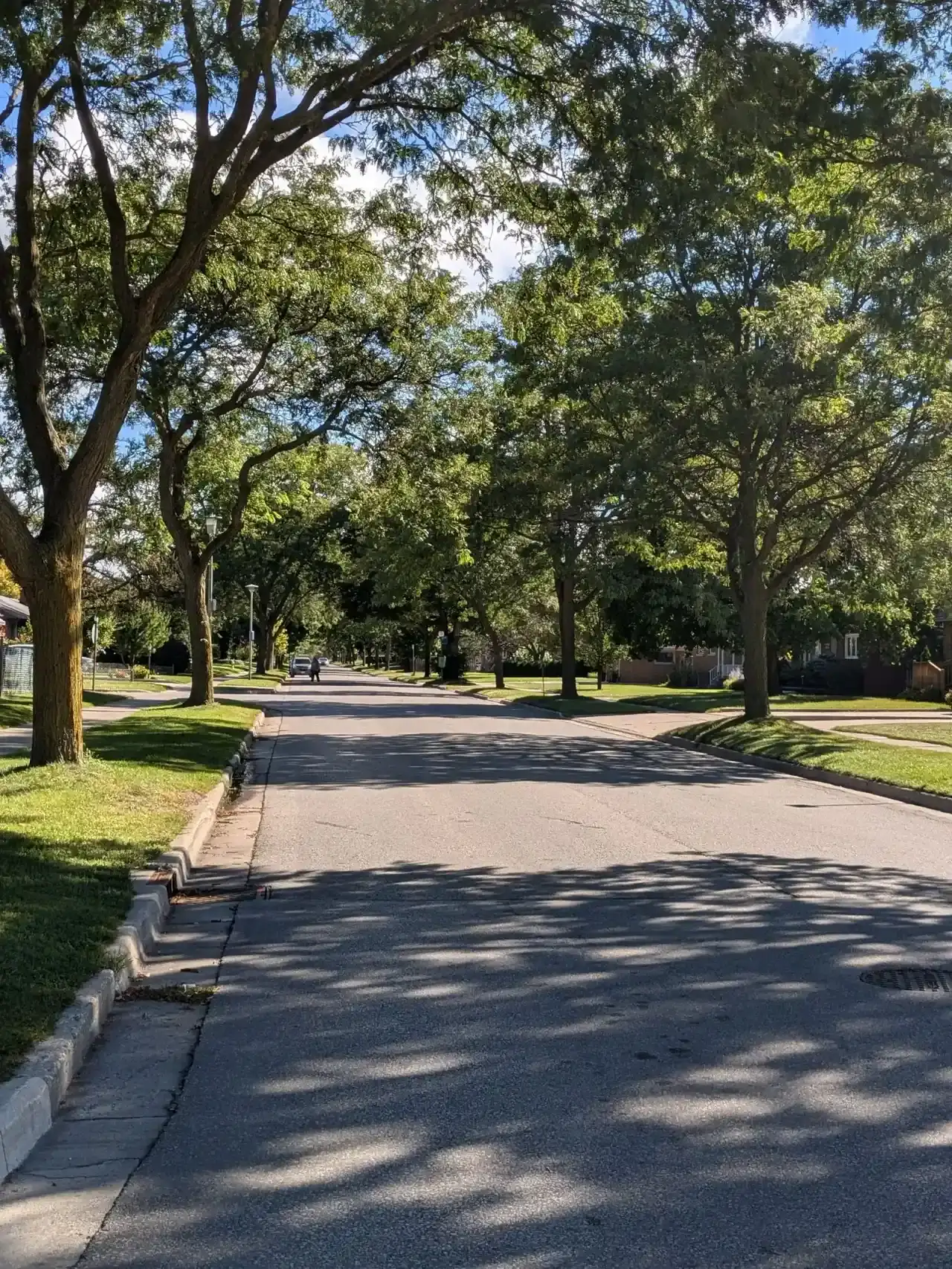
When is the best time to plant a tree?
In most of the country, fall, once summer heat has broken, followed by early spring. Roots keep growing in cool soil after leaves drop, so a fall tree has a head start before its first summer. In the hottest southern areas, late fall through winter is ideal.
- Fall
- Best in most regions. Soil is warm, air is cool and rain is usually more reliable.
- Spring
- Good, especially in cold climates and for species such as magnolia and birch that establish slowly.
- Summer
- Possible with container trees and diligent watering, but survival is lower.
How a tree should go in the ground
Call 811
Utility lines are marked before digging, even for a small hole.
Find the root flare
Excess soil is removed from the top of the root ball until the flare where the trunk widens is visible.
Dig wide, not deep
The hole is two to three times as wide as the root ball and no deeper than the flare height.
Fix the roots
Circling roots are cut or straightened. Wire baskets and burlap are removed from at least the top of the ball.
Backfill and water
Native soil goes back in without heavy amendment, and the tree is watered deeply to settle it.
Mulch
Two to four inches of mulch over a wide circle, kept a few inches off the trunk.
Matching tree size to the space
Mature size is the deciding factor. A tree that fits today can outgrow a site in fifteen years.
| Space available | Mature height to aim for | Examples |
|---|---|---|
| Under power lines | Under 25 feet | Serviceberry, redbud, crape myrtle, Japanese tree lilac |
| Narrow strip or small yard | 25 to 40 feet | Hornbeam, blackgum, trident maple, Kentucky coffeetree in cool areas |
| Open lawn, 30 feet or more from the house | 40 feet or taller | Oaks, tulip tree, bald cypress, London plane |
| Wet low ground | Varies | Bald cypress, river birch, swamp white oak, red maple |
Check with your state extension service or city forester for species that suit local soils and pests.
Planting mistakes that kill trees slowly
- Planting too deep
- The single most common error. The trunk base rots and roots grow around the stem, choking it years later.
- Volcano mulching
- Mulch piled against the trunk holds moisture on bark and invites rot and rodents.
- Leaving stakes and ties on
- Ties left past the first year can cut into the bark. Most trees need no staking at all.
- Too much amendment in the hole
- Rich soil in the hole and hard clay around it keeps roots circling the pocket.
- Too close to the house
- A large-growing species within 15 feet of a foundation is a future removal.
Container or balled-and-burlapped
Container-grown
- Light and easy to handle
- Can be planted most of the year
- Roots are often circling and must be corrected
- Usually smaller trees
Balled and burlapped
- Field-grown with soil around the roots
- Heavy and often needs equipment
- Most of the root system was cut when dug
- Larger trees available
Smaller trees establish faster. A two-inch caliper tree often catches up to a four-inch one planted the same day within a few years.
First-year signs to watch
Leaves wilting by afternoon
The root ball has dried out. Water slowly at the base.
Leaves yellowing with soggy soil
Too much water or poor drainage. Let it dry between waterings.
Small leaves and little new growth
Normal in the first year. The tree is building roots before shoots.
Bark damage near the base
Mowers and string trimmers. Widen the mulch ring.
Replacement trees after a removal
Many cities require replacement planting when a protected tree is removed, sometimes inch for inch of trunk diameter, sometimes a set number of trees per removal. A permit may name the species and the size of the replacement and set a deadline for planting.
Where a replacement cannot fit on the lot, some cities accept a payment into a tree fund instead. The details are on each city page, such as Austin and Atlanta.
Planting near the stump of a removed tree works best a few feet to one side, because the ground directly over a ground stump is mostly wood chips. See stump grinding for how deep to grind when replanting.
Tree planting questions
How often should a new tree be watered?
As a rough guide, deeply once or twice a week through the first growing season when rain is short, more in heat. The goal is moist, not soggy, soil in the root ball.
How long until a newly planted tree is established?
Roughly a year for each inch of trunk diameter at planting, so a two-inch tree needs about two years of careful watering.
Does a new tree need fertilizer?
Usually not in the first year. Fertilizer can push leaves at the expense of roots.
Can I get a street tree from my city?
Many cities run street tree planting programs, often for free or at reduced charge, for the strip between sidewalk and curb. Contact the city forester or public works.
Talk to a tree planting provider
Call to be connected with an independent tree service company near you.
(844) 955-1716Call availability varies by area and time of day
Limbwright is a referral service. Your call goes to an independent tree service company that sets its own schedule and terms. Ask for proof of insurance and a written scope before work starts. How this works
Call now
Talk to a tree service provider in your area. Have the tree's location and what it is near ready.
(844) 955-1716Call nowCall availability varies by area and time of day