Tree removal · Close quarters
Tree Removal Near a House
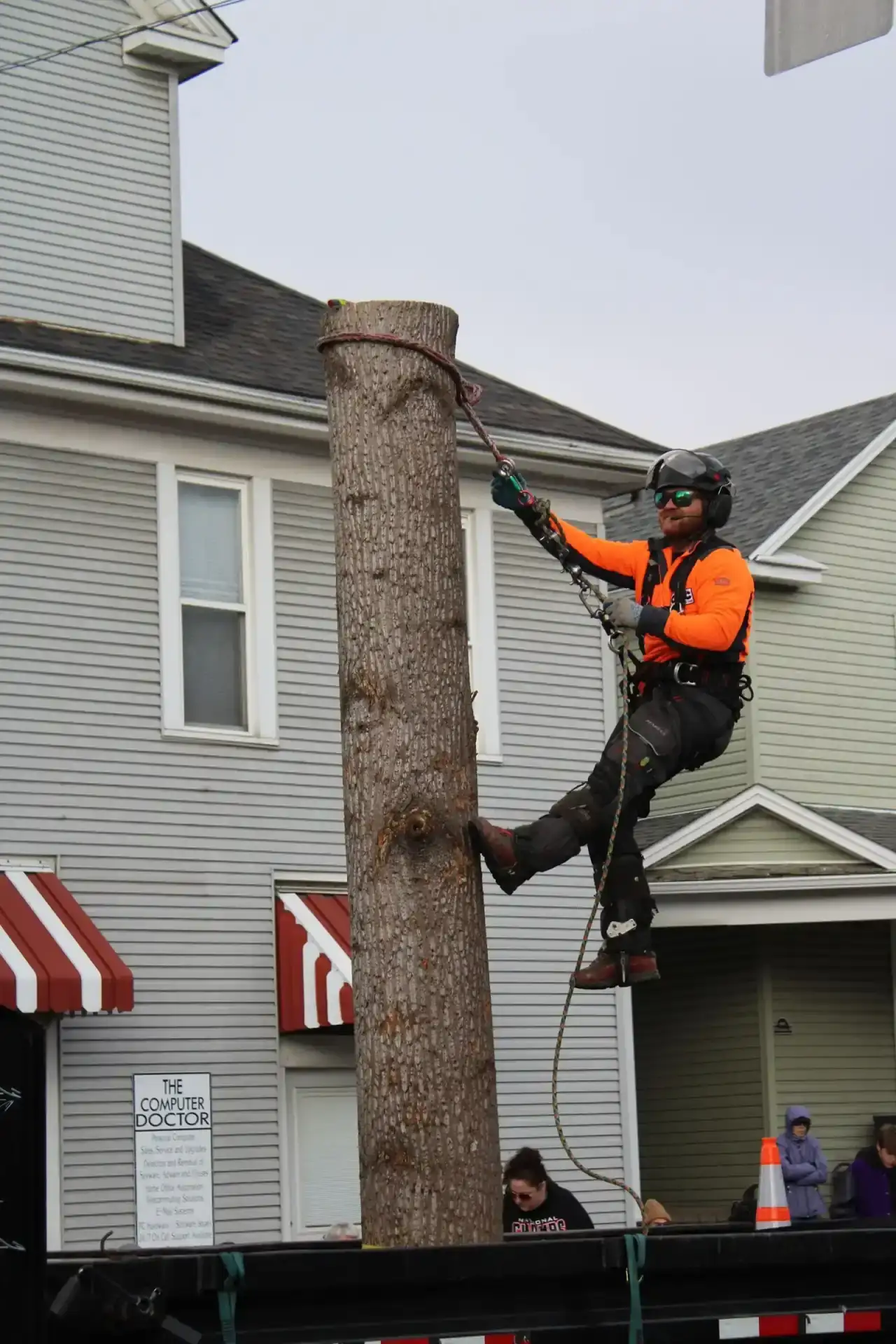
A tree within a few feet of a house cannot be felled. It comes down piece by piece, each lowered on rope or lifted out, with the crew planning every cut so nothing lands on the roof, gutters or windows.
Call availability varies by area and time of day. Calls are answered by an independent tree service provider.
How close is too close for a tree?
There is no single distance, but a large-growing tree within about 10 to 15 feet of a house often causes problems: branches on the roof, clogged gutters, roots near the foundation and a real chance of the trunk landing on the house if it fails.
- Small trees
- Dogwood, redbud and similar trees can live a few feet from a wall without trouble.
- Large trees
- Oaks, maples and pines planted near a house become a hazard as they grow over the roof.
- Leaning toward the house
- A lean toward the structure with soil heaving on the other side is urgent.
How a close-quarters removal is done
Protect the house
Plywood or mats go over decks, AC units and walkways. Gutters and lights below the work are noted.
Remove limbs over the roof
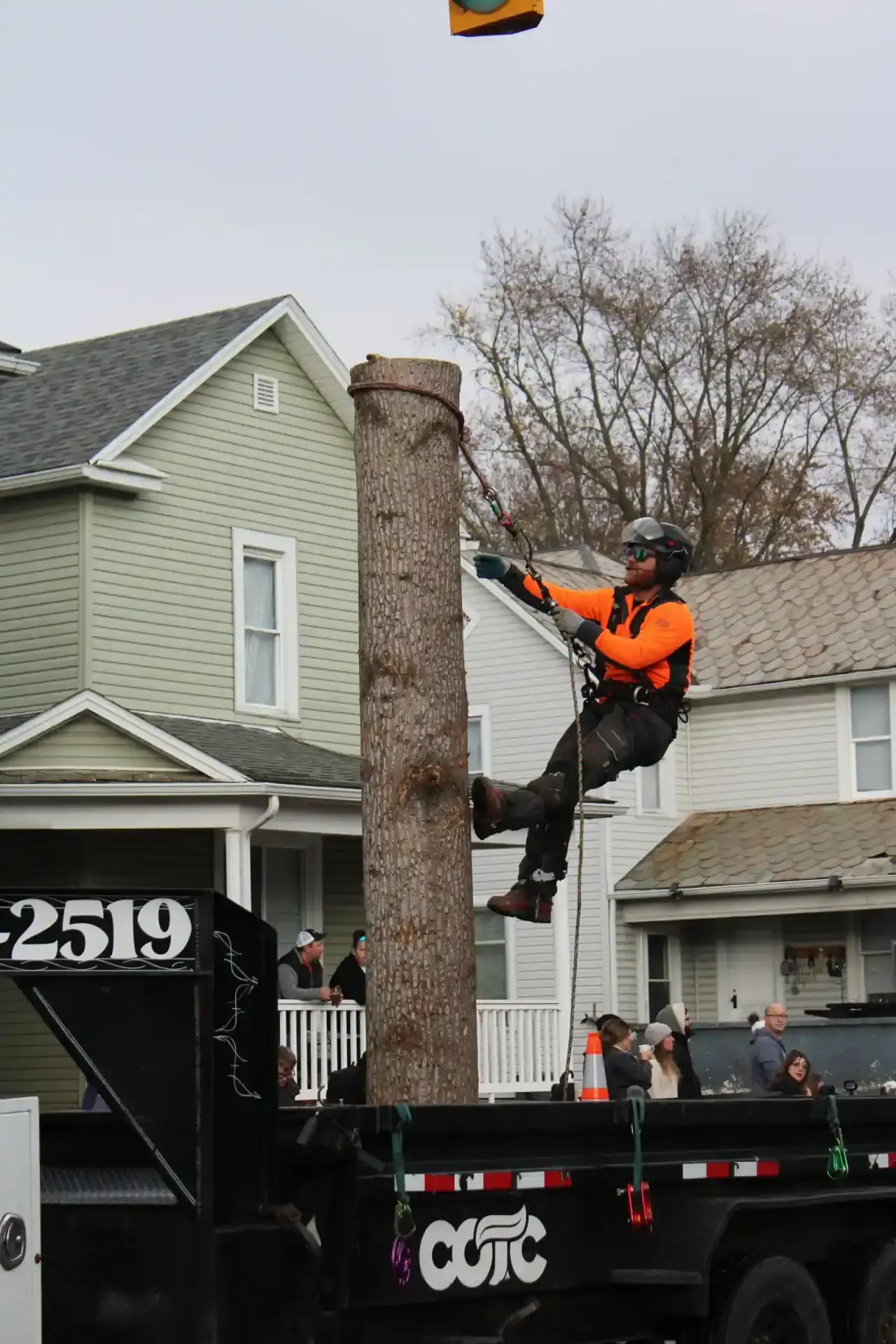
Each limb is tied off before it is cut, then lowered with a friction device controlled from the ground.
Bring the trunk down in pieces
Short sections are cut and lowered, or lifted out by crane where rope would bring them too close to the wall.
Cut the stump low
The stump is cut near the ground. Grinding close to the foundation needs care.
Clean the roof and gutters
Leaves, twigs and sawdust from the work are cleared.
What a tree near a house can damage
- Roof
- Branches rubbing shingles wear through them, and debris holds moisture.
- Gutters
- Leaves, needles and seeds block them every season.
- Foundation
- Roots seldom crack sound foundations directly, but in shrink-swell clay soils, trees drawing water can add to settling.
- Sewer lines
- Roots enter old clay and cast iron pipes through cracked joints.
- Siding and paint
- Shade and moisture encourage mildew and rot on the shady side.
Method by situation
| Situation | Usual approach | Why |
|---|---|---|
| Open yard on one side | Limbs lowered, trunk felled away from house | Fastest if there is a clear drop zone |
| House on one side, fence on another | Lowering by rope for most of the tree | Pieces controlled into a small gap |
| Surrounded by structures | Crane removal | Nothing can be dropped or swung |
| Tree dead or cracked | Crane or aerial lift where possible | The tree may not bear rigging loads or a climber |
Prune it back or take it out
Prune and keep
- Tree is healthy and a suitable species
- Roof clearance can be kept with periodic work
- No lean or root damage
- Shade is valued
Remove
- Trunk is within a few feet of the foundation and still growing
- Repeated roof damage
- Decay, lean or root lifting
- Species prone to breakage, such as Bradford pear or silver maple
If keeping it, see branch clearance from the roof for how much to cut back and how often.
Signs a house-side tree needs attention now
New lean toward the house
Especially after storms or heavy rain. Look for cracked soil or lifted roots on the opposite side.
Dead limbs over the roof
Dead wood falls without warning, often in light wind.
Cracks in the trunk
A vertical crack or split fork near the house is a priority.
Fungus at the base
Root decay can drop a tree that looks healthy above ground.
Roots and stump after removal
Once a tree near a house is gone, its roots stop growing and begin to decay. In most soils that causes no problem. In expansive clay, the soil can gain moisture back slowly and swell, which is why some engineers advise against removing a very large tree right beside a foundation during a drought.
The stump is usually ground. A grinder can work within a foot or two of a foundation, though the last few inches near the wall may be done by hand. Where a patio or addition will go, stump removal takes out the root mass.
Questions about trees near houses
Will removing a tree near my house cause foundation problems?
In most soils, no. In expansive clay soils in places such as Texas and Oklahoma, removing a large tree can change soil moisture. A structural engineer can advise if the house already shows settling.
Does homeowners insurance pay to remove a healthy tree near the house?
Generally not. Policies usually cover trees that fall and damage covered structures, not preventive removal.
Can roots be cut instead of removing the tree?
Small roots can be. Cutting large roots near the trunk can kill the tree or make it unstable.
How do I know whose tree it is if it is on the property line?
Trunk location usually decides ownership. A survey shows where the line is.
Talk to a tree removal near a house provider
Call to be connected with an independent tree service company near you.
(844) 955-1716Call availability varies by area and time of day
Limbwright is a referral service. Your call goes to an independent tree service company that sets its own schedule and terms. Ask for proof of insurance and a written scope before work starts. How this works
Call now
Talk to a tree service provider in your area. Have the tree's location and what it is near ready.
(844) 955-1716Call nowCall availability varies by area and time of day