
Cambridge, Massachusetts
Tree Removal and Tree Service in Cambridge
In Cambridge, any tree on a lot with a trunk 6 inches or more in diameter at 4.5 feet is a Significant Tree, and removing one requires a permit from the City Arborist under the Tree Protection Ordinance. The city has tightened that rule repeatedly since 2018 as it works to stop canopy loss.
- County
- Middlesex
- Tree rules
- Cambridge Municipal Code Title 8, Chapter 8.66, Tree Protection Ordinance
- Key local rule
- City Arborist permit to remove any Significant Tree, 6 inches in diameter or more
- Electric utility
- Eversource
- Main hazards
- Nor'easters, heavy wet snow, old street trees, very small lots
The Tree Protection Ordinance
Chapter 8.66 of the Cambridge Municipal Code defines a Significant Tree as any tree on a lot with a diameter of 6 inches or more measured 4.5 feet above the ground. Removing one requires a tree removal permit from the City Arborist and is subject to the ordinance's rules, including mitigation for trees removed.
From 2018 to 2021 the city ran temporary amendments, sometimes called the tree-cutting moratorium, that used an 8-inch threshold on private land. The 2021 amendments made protection permanent and lowered the size to 6 inches.
Mitigation may be waived in special circumstances, including emergencies, required utility projects, city park projects, trees causing significant harm to an adjacent structure, and dead or dangerous trees.
Is my tree a Significant Tree?
If its trunk is 6 inches or more across at 4.5 feet, yes. That is a circumference of about 19 inches, roughly the size of a young maple ten years after planting. Multi-stem trees and dead or dangerous trees have their own handling, so ask the City Arborist before cutting.
- Under 6 inches
- Not a Significant Tree.
- 6 inches and over
- Permit required before removal.
- Street and park trees
- Public trees managed by the city's Urban Forestry division.
Why Cambridge tree work is different
- Tiny lots
- Triple-deckers and row houses leave rear yards of a few hundred square feet, with no room to drop anything.
- Alley and driveway access
- Many backyards are reached through a narrow side passage or a neighbor's yard.
- Overhead wires
- Dense service drops and lines cross most yards.
- Crane permits
- Street occupancy for a crane needs city permits and sometimes police details.
- Neighbor trees
- Trees on shared lines are common. Ownership follows the trunk, and work on a neighbor's side needs their consent.
- Old street tree stock
- Norway maples, lindens and honeylocusts planted in the mid-20th century are reaching the end of their lives in narrow tree pits.
Signs worth an arborist's visit
Norway maples with girdling roots
A common street and yard tree here that often chokes itself.
Heavy limbs over a roof after snow
Wet snow and ice are the main winter risk.
Fungus on an old oak or maple
Decay in mature trees on small lots, where any failure lands on a house.
Roots lifting a foundation wall or walk
Common with large trees planted close to triple-deckers. An arborist report helps if mitigation relief is sought.
Thinning honeylocust
Cankers and stress from compacted soil.
Getting a removal permit
Measure the diameter
At 4.5 feet above the ground.
Document condition
An arborist report helps for dead, dangerous or damaging trees.
Apply to the City Arborist
Through the city's online permitting.
Mitigation
Replacement planting or a mitigation payment, unless waived.
Removal
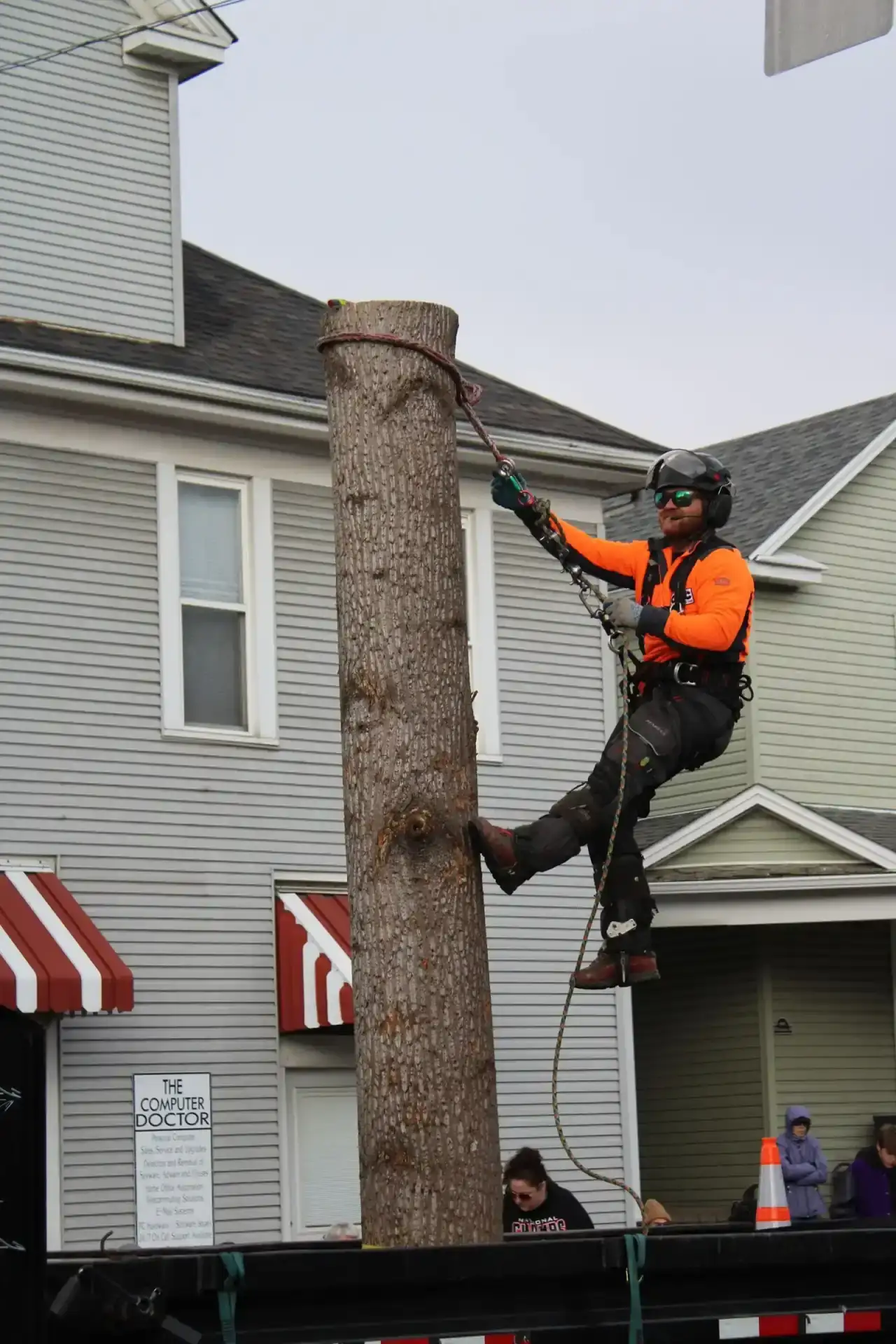
Usually rigged and lowered piece by piece on small lots.
How the rules changed
| Period | Threshold on private land | Notes |
|---|---|---|
| Before 2018 | Larger trees, mainly in development | Fewer private trees covered |
| 2018 to 2021 | 8 inches | Temporary amendments during urban forest planning |
| 2021 onward | 6 inches | Permanent Significant Tree definition |
Cambridge tree questions
Can I remove a dead tree in Cambridge without a permit?
A permit is still the route, but dead and dangerous trees are among the cases where mitigation may not be required.
Does Cambridge regulate pruning?
Removal is what needs the permit. Severe pruning that destroys a tree may be treated as removal.
Who maintains street trees?
The city's Department of Public Works Urban Forestry division.
Does Somerville have the same rule?
No. Neighboring cities, including Somerville and Boston, have their own rules.
How long does a Cambridge tree permit take?
Allow several weeks for review, longer if the City Arborist needs to inspect the tree or the application is tied to a building permit.
Greater Boston pages
Reach a tree service in Cambridge
Call to be connected with an independent tree company that works in the Cambridge area, or leave your number and one will call you back.
(844) 955-1716Call availability varies by area and time of day
Limbwright is a referral service. Your call goes to an independent tree service company that sets its own schedule and terms. Ask for proof of insurance and a written scope before work starts. How this works
Call now
Talk to a tree service provider in your area. Have the tree's location and what it is near ready.
(844) 955-1716Call nowCall availability varies by area and time of day