
Indianapolis, Indiana
Tree Removal and Tree Service in Indianapolis
Indianapolis asks for one specific thing: a flora permit before anyone prunes, removes or plants a tree in the public right-of-way. On your own lot the city generally leaves the decision to you.
- County
- Marion
- Tree rules
- City permitting office and the urban forestry section of Public Works
- Key local rule
- Flora permit required for any tree work in the public right-of-way
- Electric utility
- AES Indiana
- Main hazards
- Derechos, tornadoes, thunderstorm wind, occasional ice
What the flora permit covers
A flora permit is the city's authorization to plant, prune or remove trees and shrubs in the right-of-way. That area usually includes the strip between sidewalk and curb, and on streets without sidewalks it can extend several feet into what looks like the front lawn.
The adjoining owner may apply, and so may a contractor on the owner's behalf. Removal is approved for dead, dying and hazardous trees and for documented conflicts, and replacement may be a condition.
Trees fully on private lots are not covered by the flora permit. The zoning ordinance does have tree preservation and heritage tree provisions, which apply when land is being developed or redeveloped. Lawrence, Beech Grove, Speedway and Southport are separate municipalities inside the county with their own rules.
Where the big trees are
The neighborhoods laid out between 1890 and 1930 hold the city's largest trees. Irvington, Meridian-Kessler, Butler-Tarkington, Woodruff Place and the Old Northside have oaks, sycamores, tulip trees and silver maples that now reach 80 to 100 feet.
Lots there are deep and narrow with alleys behind, and garages, fences and overhead lines crowd the back. A removal usually means a crane from the alley or street, or a long day of rigging.
The townships developed after 1960 are different. Trees are younger, ash and callery pear were planted heavily, and both have since become removal work for separate reasons: one from an insect, the other from its own weak structure.
Indianapolis trees and what usually happens to them
| Tree | Typical setting | Usual outcome |
|---|---|---|
| Silver maple | Older city lots | Storm breakage, decay, eventual removal |
| Tulip tree | Throughout, especially the north side | Top and limb failures in wind. Otherwise long-lived. |
| Ash | Suburban streets and yards | Dead or dying unless treated |
| Callery pear | Subdivisions and commercial sites | Splits by 15 to 20 years |
| Bur and white oak | Older estates and parks | Worth keeping. Protect the roots. |
Wind events in central Indiana
- June 29, 2023
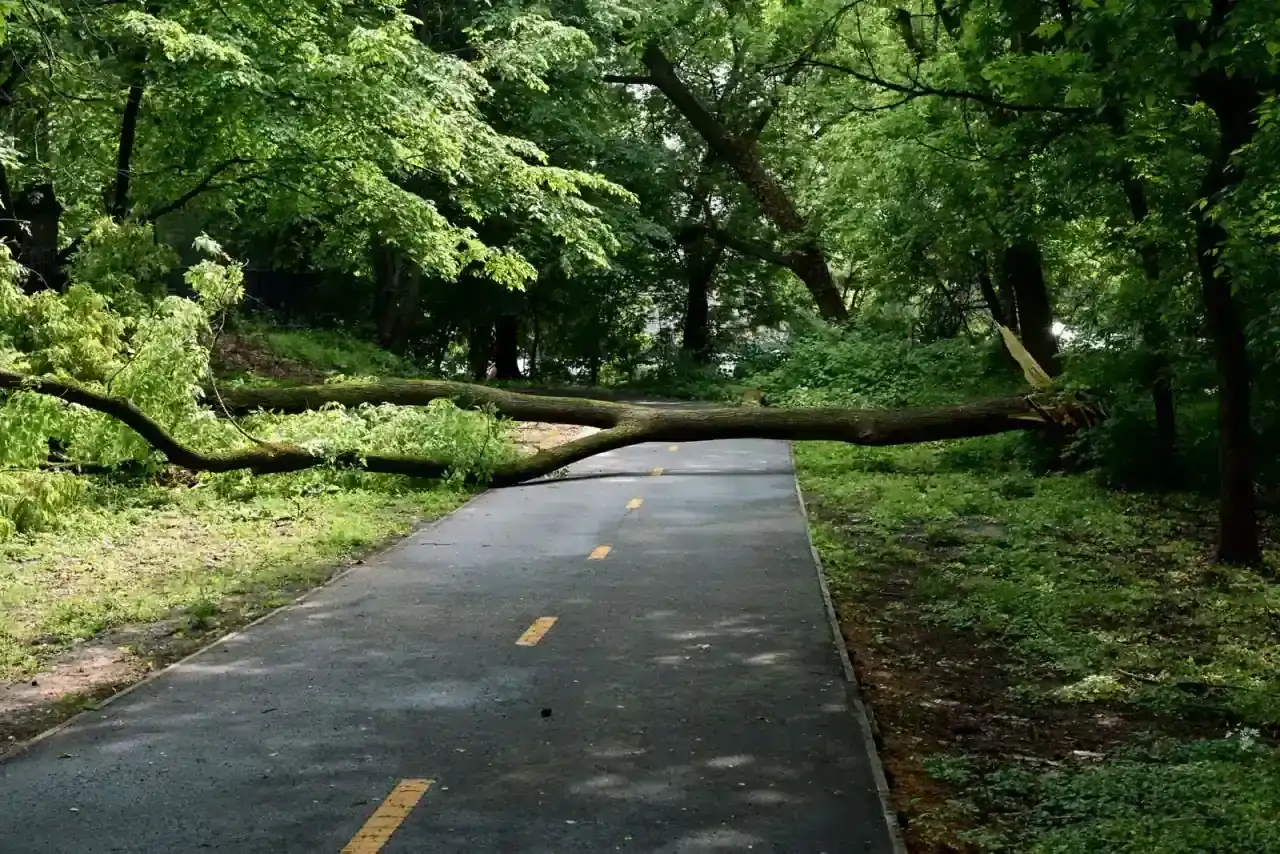
- A derecho crossed central Indiana at midday with gusts of 70 mph or more. Outages lasted for days.
- Tornadoes
- The metro area sees them most years. The September 2002 tornado tracked across the south and east sides.
- Remnants of Ike, 2008
- A windy, rainless afternoon that broke limbs from Evansville to Indianapolis.
- Ice
- Less frequent here than in southern Indiana, but damaging when it comes.
Which office or company to call
- Act now
A right-of-way tree is down in the street
Report it to the Mayor's Action Center.
- Act now
A yard tree is on the house or blocking the drive
Call a tree service. See fallen tree removal.
- Plan it
You want a right-of-way tree pruned or removed
Apply for a flora permit or have your contractor do it.
- This week
A dead ash stands near the house
Book removal while it can still be worked safely.
Common defects in the city's older trees
A long crack below a fork
The classic silver maple failure, usually toward a house or garage.
Hollow at the base with carpenter ants
The ants are a symptom. Decay came first.
Large limbs dead at the tips
Root trouble, often from trenching or new paving.
Pear with bark squeezed into the main fork
It will split, usually under snow or wind.
Indianapolis tree service questions
Do I need a permit to remove a tree in Indianapolis?
Only if the tree is in the public right-of-way, where a flora permit is required. Trees fully on a private residential lot are generally not regulated.
How do I know where the right-of-way ends?
It varies by street. The city's permitting office can tell you, and county property maps show approximate lines. Do not assume it stops at the sidewalk.
Who is responsible for removing a right-of-way tree in Indianapolis?
The city removes hazardous public trees as resources allow. An owner who wants faster action can obtain a flora permit and hire a contractor themselves.
Are there programs that plant trees in Indianapolis?
Yes. A local nonprofit works with the city to plant street and yard trees in many neighborhoods each year.
Reach a tree service in Indianapolis
Call to be connected with an independent tree company that works in the Indianapolis area, or leave your number and one will call you back.
(844) 955-1716Call availability varies by area and time of day
Limbwright is a referral service. Your call goes to an independent tree service company that sets its own schedule and terms. Ask for proof of insurance and a written scope before work starts. How this works
Call now
Talk to a tree service provider in your area. Have the tree's location and what it is near ready.
(844) 955-1716Call nowCall availability varies by area and time of day